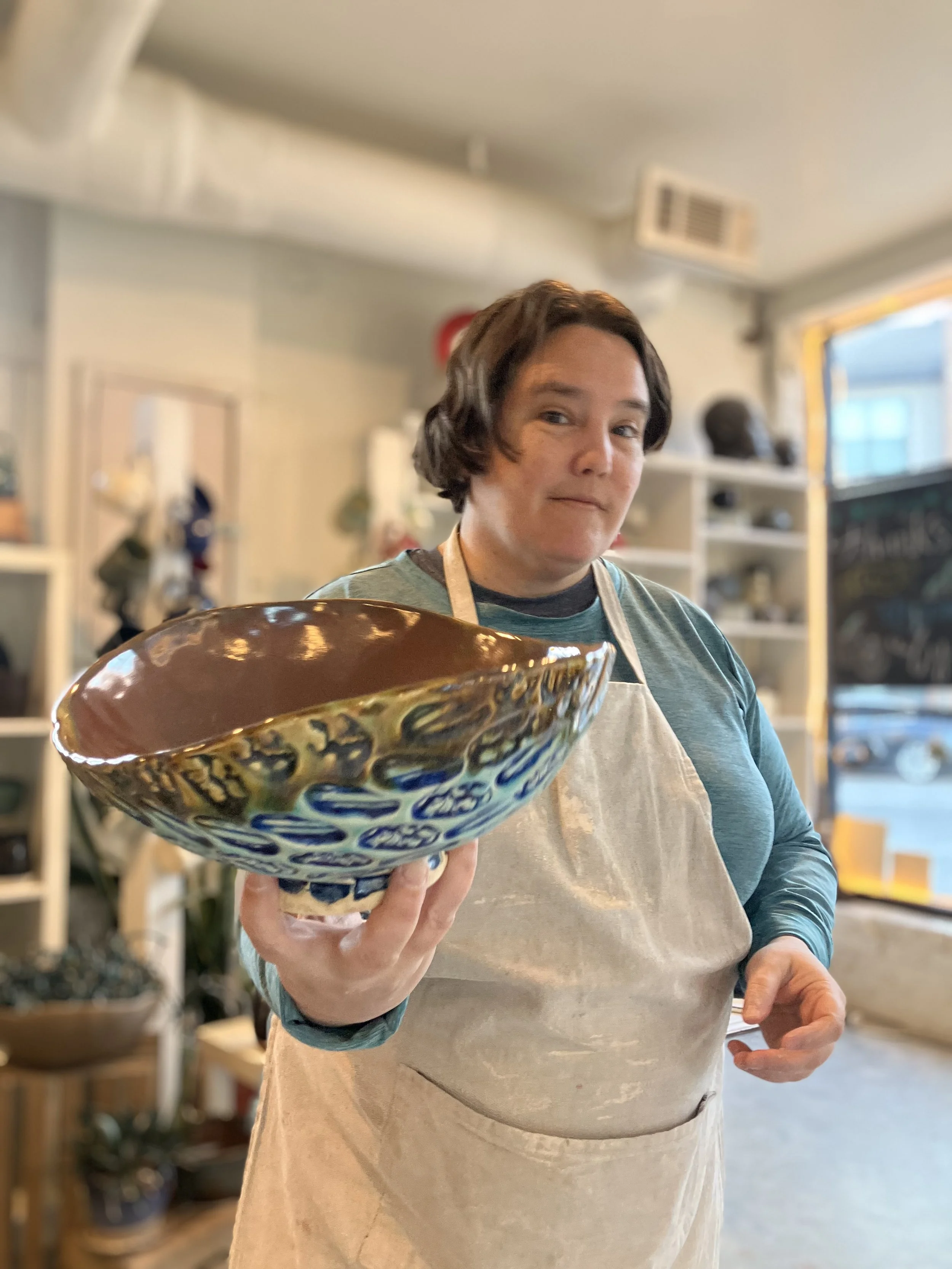
About Lillian Bolster
Lillian Bolster is a ceramic artist working out of the Atlanta Clayworks in Atlanta, Ga. She creates hand-built pottery and sculpture that is heavily inspired by nature.
For me it has always been about touch and feel.
As kids, a lot of people play with playdough and make mud pies. At least many who grew up pre-smart phones and computers and leaned towards being outdoorsy/feral. That was me. As a kid I was arty and tactile and loved doing things with my hands. So whenever possible, my parents put me in art summer camps which frequently would include clay projects. One time it was a dinosaur. Another time a slab-built cityscape. Occasionally they’d purge some of my childhood art projects, and some now grace their front garden as yard art.
Expressing myself through visual art has always come easier for me so art class was always my favorite class in school. In high school, I was offered a scholarship to take a class at Callanwolde art center in Atlanta and I picked a hand building ceramics class. I fell in love with the feeling of creating with clay. Then came college at UNC Asheville, where I knew I wanted to major in art but hadn’t decided which medium would be my focus. I took a Ceramics 1 class and I was sold. With each successive class I learned there were so many creative avenues to express myself through clay. Making with clay grounded me and I knew I wanted to continue making ceramics after graduating.
I have always made very tactile pottery by making textured hand built pottery. I love the wonky organic feel you get with pinch pots and slab built pottery, adding texture with hand made stamps. I like the juxtaposition of the structured formalness of handmade lace with organic bits of stamped clay. Adding my incised designs allows me to connect with my sketchbook doodles and patterns.
The ceramics I make invites the viewer to touch — transferring my joy of feeling, smoothing, touching, pinching, incising and forming clay to the recipient.
I fire in mid-range (cone 6, 2192 degrees Fahrenheit) electric kilns and occasionally in high-fire (cone 10, 2380 degrees Fahrenheit).